Showing posts with label Commentary. Show all posts

Sunday, April 30, 2017

Memorial Day

Tonight Israel will mark the beginning of Yom HaZikaron - Memorial Day, for those who might not have known. It is a day when the whole nation pays its respects to those who made the ultimate sacrifice to secure Israel's freedom. On this day, when the sirens wail, all of Israel will come to a standstill. Buses, cars, pedestrians, all stop. The drivers stand at attention beside their vehicles. It is a day to remember, in a world where memory has become a fleeting thing, so easily discarded or lost.

I see in the news that the roll of those who have died in the line of duty, defending Israel, has grown by 60 in the past year, to 23,544. But the statistics do not convey the full story. In a small nation, where everyone has known friends or family who were lost, every statistic was personal, they were all felt by someone. The reminders are everywhere. As in the poem by the late Yehuda Amichai,
Mr. Beringer, whose son
fell at the Canal that strangers dug
so that ships could cross the desert,
crosses my path at Jaffa Gate. 
He has grown very thin, has lost
the weight of his son.
That's why he floats so lightly in the alleys
and gets caught in my heart like little twigs
that drift away.
[1]
Tomorrow night, will commence Independence Day - Yom HaAtzmaut in Israel, when Israelis and Jews around the world will celebrate Israel's modern day rebirth. It is a celebration with inflatable hammers and silly string. But before there can be an Independence Day in Israel, there must always be a Memorial Day.  In Israel, there cannot be one without the other.


References:
[1] From: "Seven Laments for the War-Dead" by Yehuda Amichai, in: The Selected Poetry of Yehuda Amichai, ed. and trans. by Chana Bloch and Stephen Mitchell (New York, Harper & Row, Publishers, 1986).

Monday, December 5, 2016

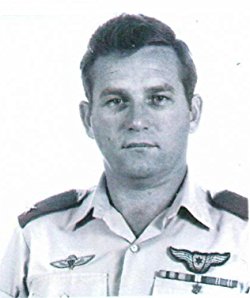
Ran Ronen: The Passing of Memory

This past weekend marked the passing of an Israeli aviation legend, Brig. Gen. Ran Ronen (Pekker). Ran flew in every Arab-Israeli war from the 1956 Sinai Campaign to the Yom Kippur War of 1973. But he is best remembered as the commander of Israel's 119 Squadron, the "Bats," both before and during the Six Day War.

In a nation that has seen more than its fair share of combat worn veterans, Ran Ronen stood out as among the most renowned. He was not merely one of the greatest combat pilots of all time. In the words of fellow veteran Menachem Shmul (who served under him), Ran Ronen was "the greatest squadron commander ever."

Ran epitomized the ethos of the Israeli commanding officer, demanding excellence from his men, and leading them into battle by personal example. As commander of the "Bat" squadron, Ran chose to personally fly the most dangerous of missions in the years leading up to the Six Day War: flying the reconnaissance sorties deep into Egyptian territory that paved the way for Israel's stunning aerial victory in the Six Day War. As the commanding officer of the "Bats," he developed the demanding aerial gunnery standards that were essential to preparing a generation of Israeli pilots for future war. His example as a leader and pilot set the standard by which Israeli squadron commanders would be judged for decades to come.

During the War of Attrition, Ran Ronen was tasked to personally rebuild Israel's first F-4 Phantom squadron, after its morale had been shattered by the tragic death of their beloved squadron leader, Shmuel Hetz. And during the Yom Kippur War, as the commanding officer of Israel's largest air base, Ran Ronen continued to fly operational missions deep into enemy air space, during some of the darkest days in the history of Israel's air force.

It is not only Israel's air force that lost a legend this past week. Rather, it was a piece of Israel's collective memory that has passed away. The dark clouds of those decades, when Israel's very existence was an open question mark on the world stage, have often been lost on succeeding generations. Too few, it seems, recognize the personal sacrifice that a generation of pioneers, and their children after them, were called upon to make to secure the survival of the Jewish people.

Ran Ronen was laid to rest in Kfar Vitkin this past week, the moshav where he and his future wife, Heruta had once been raised. He was 80 years old, finally falling victim to cancer. To him, and many like him, succeeding generations are all alike indebted.


http://www.jpost.com/Israel-News/Saying-good-bye-to-Ran-Pekker-the-legendary-IAF-combat-pilot-474450
http://www.israelnationalnews.com/News/News.aspx/221218

Friday, October 7, 2016

In Memorial: Maj. Ohad Cohen Nov

Maj. Ohad Cohen Nov (photo courtesy of his family)
An Israeli fighter pilot died this past week, while attempting to eject from his stricken airplane. His navigator survived with minor injuries. The event should serve as a reminder for just how dangerous operating these high performance aircraft really is.

The pilot, Maj. Ohad Cohen Nov, was buried in his home town of Mazor - a Moshav (farming village) east of Tel Aviv.  The 34 year old pilot, who was recently promoted to deputy squadron commander of the 119 Squadron, leaves behind a daughter and a pregnant wife. He is described by those who knew him as, "simply a great guy, a fabulous uncle, and the number one brother."
http://www.timesofisrael.com/maj-ohad-cohen-nov-killed-in-f-16-crash-is-buried-in-hometown-mazor/
http://www.jpost.com/Israel-News/Israeli-pilot-Ohad-Cohen-Nov-remembered-as-simply-a-great-guy-469579

Flying a supersonic fighter is hazardous even in peacetime. These are extremely complicated machines, operating at very high speed, often where the slightest mistake can mean almost certain death. For a small nation such as Israel, the death of one of its sons is not taken lightly. The men (and now women) who operate these aircraft risk their lives to do so because their nation's security depends on them. It is a daily gamble, but a necessary one.

According to reports, Maj. Nov's airplane was returning from an air strike in Gaza (in retaliation for rockets fired at Israeli towns), when his aircraft experienced technical difficulty. He was flying with assymmetric loading - one wing free of bombs and the other still loaded - and had already aborted an attempted landing. It was during the second landing attempt that his aircraft reportedly caught fire, forcing the pilot and his navigator to eject. In the ejection sequence for the two-seat aircraft, the navigator ejects first, and the pilot immediately after. In a situation such as this, those seconds can be crucial.
http://www.ynetnews.com/articles/0,7340,L-4863508,00.html

As his family mourns his loss, we should all be reminded of the sacrifices that the young men and women of the IDF are called upon to make every day, and without which there would be no Israel, no Jewish State, and no man, woman or child left alive in Israel.

Sunday, July 10, 2016

National Best Interest

As I discuss in a recent Opinion/Editorial posted in the Jerusalem Post International Edition, despite what some of Israel's detractors might profess, U.S. military assistance to Israel has never been an act of charity: it is a strategic investment dictated by America's own national self-interest

Providing military assistance to Israel is far, far cheaper than sending U.S. soldiers to fight wars in the Eastern Mediterranean, and far cheaper than similar U.S. investments to defend NATO in Europe, or U.S. allies in the Far East.

In that same vein, as a strategic investment, getting the most out of U.S. military assistance to Israel also dictates that the U.S. should leverage Israeli resources and technology, wherever possible. Israeli innovation has been a constant source of fresh ideas and practical application that has benefited the defense of both nations.

Friday, March 18, 2016

An Aerospace Firm - And a Window into a Different World

Israel Aerospace Industries (IAI) announced a plan this past week to launch a new push to enter additional civilian aerospace markets:
https://www.flightglobal.com/news/articles/israel-aerospace-industries-plans-civil-push-422887/

This is not the first time that IAI has sought to rebalance its civil versus military work portfolio. What makes this particular announcement so unusual is the context:
Attempts to lay-off around 1,500 workers have so far failed because of strong union and political opposition, leaving the company seeking another solution to alleviate its poor financial performance.

In other words, with a work force of just over 16,000 employees - a far cry from its heyday in the mid-1980s when IAI employed over 22,000 - IAI is still struggling to stand on its own merits financially. This is in no small measure due to its role as a government-owned corporation, and its relative weakness vis-a-vis the demands of its labor unions.

IAI has identified a number of civilian aircraft programs that it is targeting to expand its portfolio, including a light business jet, and bids to attract additional subcontract work from Boeing and other major manufacturers.

The reality, however, is that aerospace is and always has been an intensely competitive industry. The drive to continuously develop new technologies to maintain a market advantage is relentless. This is very different from other major manufacturing industries - most of which rely less on technology development and more on repackaging existing technologies in new ways. Major aerospace development efforts require enormous financial investment, and the risk of missed milestones, even for a successful product, can challenge the financial well being of even the most successful companies - as Canada's Bombardier has most recently demonstrated. The fact that IAI is therefore struggling to reap the financial rewards of this industry should therefore come as no surprise. But IAI is not just another aerospace firm. For Israel, it represents an investment in Israel's defense capabilities, and the ability to develop new and innovative means to provide Israel's armed forces with an advantage on the battlefield.

In this context therefore, it should be expected that IAI has and will continue to struggle. Regardless of changes in the world around it, IAI remains an Israeli national defense asset that also moonlights as a civil aerospace firm as a supplement to its primary responsibility.

Friday, January 15, 2016

A Familiar Cast - A Familiar Script

For those of us who followed the development of the Lavi fighter program decades ago, there was a familiar name in the news this past week - one providing current emphasis to how little has truly changed in Washington.

Thomas Pickering was ambassador to Israel from 1985 to 1988, at the height of the behind-the-scenes campaign - led by then Secretary of Defense Caspar Weinberger and aided by many in the rank and file of the State Department - to convince Israel to cancel the Lavi program. As ambassador, Pickering helped to shuttle Weinberger's protege, Dov Zakheim between meetings with Israeli officials: both arranging the meetings and reinforcing Zakheim's message after he returned to Washington. These included meetings between Zakheim and the leadership of Israel's religious parties, aimed at taking advantage of Israel's secular-religious divide in the campaign to cancel the program. Moreover, Pickering performed these roles, despite the fact that his lobbying campaign was never approved by Secretary of State George Shultz, who had been personally responsible for securing President Reagan's endorsement for the Lavi program and for U.S. funding to support it.[1]

Thomas Pickering appeared again in the news this past week, in a series of emails amidst the trove of official documents recovered from Secretary of State Hillary Clinton's personal email server. In the emails, dated from December 2011, Pickering suggests that the United States should covertly engage "third parties and a number of NGOs" (non-governmental organizations) to engage in "protests and demonstrations to put peace back in the center of people's aspirations."[2]

Pickering's proposals were not the first, nor the last time that State Department officials and advisors had proposed that the United States should intervene in Israel's internal politics. They do however, underscore how enduring the pervasive, corporate culture of the State Department has become. Pickering was not some political appointee to an obscure ambassadorship. Rather, he was a high ranking career diplomat, who has held ambassador roles to Israel, Jordan, India, Russia, and the United Nations.

What is most disturbing about Pickering's proposals to Secretary of State Hillary Clinton is not that a State Department adviser was again suggesting that the U.S. should covertly intervene on the internal Israeli political scene, but rather the sheer naivete of his proposal. To believe that the U.S. could engage the Palestinian masses to launch "protests and demonstrations", and that such protests would remain peaceful and not degenerate into another round of violence, speaks volumes for how disconnected the State Department elite has become from reality. Israel is today combating a wave of stabbing attacks and shootings, perpetrated by Palestinians whose leaders continue to hale such violence as the acts of "martyrs". Only three weeks ago, for example, two Israelis died in Jerusalem as the result of one such stabbing attack - the latest in a string of such violence.[3] Only this past week, the Palestinian Authority - Israel's diplomatic partner under the Oslo Accords - declared the perpetrator of another such attack (a shooting that killed two Israelis) to be a "martyr" for the Palestinian cause.[4] The disconnect between the rose-colored narrative to which the State Department's leading diplomats subscribe, and the deadly consequences of the real world could hardly be more stark.

There was a familiar name in the news this past week. A familiar reminder of how little has truly changed on the Washington scene.


References:
[1] John Golan, Lavi: The United States, Israel, and a Controversial Fighter Jet (Sterling, VA: Potomac, 2016).
[2] Gil Ronen, "Clinton Mulled Secret Plan to Spark Palestinian Unrest," Erutz Sheva (January 11, 2016), http://www.israelnationalnews.com/News/News.aspx/206290.
[3] Daniel K. Eisenbud, "Two Israelis Wounded in Jerusalem Terror Attack Die of Injuries," The Jerusalem Post (December 23, 2015), http://www.jpost.com/Arab-Israeli-Conflict/Breaking-At-least-three-wounded-in-suspected-stabbing-attack-at-Jerusalems-Jaffa-Gate-438171.
[4] Khaled Abu Toameh, "Palestinian Authority Joins Hamas in Declaring Tel Aviv Gunman 'a Martyr,'" The Jerusalem Post (January 9, 2016), http://www.jpost.com/Arab-Israeli-Conflict/Palestinian-Authority-joins-Hamas-in-declaring-Tel-Aviv-gunman-as-martyr-440925.

Monday, July 13, 2015

Review of CSBA Study on Future Air Dominance - Video and PDF File

Video edition of independent review:

Original chart pack is available below:

Review of CSBA Study on Future Air Dominance


A study published this past April by the Center for Strategic and Budgetary Assessments raises some important questions about what the future of air combat, and air dominance holds in store.  The study projects forward to make recommendations for the next ten to fifteen years of defense spending, based around past and current trends.  Among the conclusions drawn by this study, and certainly the one that will draw the most attention, is the assertion that:
"An effective sixth-generation 'fighter' may look similar to a future 'bomber' and may even be a modified version of a bomber airframe or the same aircraft."
In other words, the study is suggesting that in the future, air combat maneuverability will become less important, and that a future fighter will need to carry lots of weapons and travel over long distances.

The CSBA study highlights a number of trends in air combat from the past half century, which bear repeating:
  • The key role of situational awareness
  • The transition from guns-only to missile-dominated engagements
  • The integration of hostile IFF (identify friend-or-foe) interrogation systems
  • The increasing role of AWACS in battlefield management
  • The emergence of infrared search and track systems (IRSTS)
The study also takes note of the growing concern surrounding the United States' force projection capabilities in the Far East, where there are relatively few friendly air bases and where the distances are much greater.

Proposed CSBA model for future air dominance (CSBA Graphic)
What the study proposes as a solution to this scenario, is a new air dominance model: one which relies on a combination of bomber-sized command and control centers and unmanned air vehicles.  It is assumed that both the command and control aircraft and the UAVs would be low-observable aircraft, and that they would be armed with beyond visual range missiles.  The study further suggests that in a future stealth-on-stealth engagement, where the opposing aircraft would likewise have some measure of low observable capability, that the principle sensor for detecting, tracking and firing upon an opponent would become infrared search and track systems (IRSTS).

Unfortunately there were a number of gaps in the data set from which the CSBA study drew its conclusions.  The study does not differentiate between BVR missile kills that were launched from beyond visual range, and those that were launched from within visual range.  In other words, just because it was a radar-guided missile that made the kill, that could have been launched from beyond visual range, does not necessarily mean that it was launched from beyond visual range.  The study also accepts at face value the air-to-air kill claims made during the Iran-Iraq war of the 1980s - failing to take into account the vast cultural differences in combat reporting between the West and the Middle East.  This is equivalent to accepting the reports of "Baghdad Bob" during the 2003 Iraq War as if they were gospel.

Fiberglass mockup hailed as a "fighter" by  Iranian
authorities in 2013 (Mashregh News)
The study takes at face value some 290 air-to-air kills from the Iran-Iraq war of the 1980s.  To put that into perspective, that's more than all of the other air-to-air kills, from all other air wars, in the 1980s, 90s, and 2000s - combined.  The study further credits the Iranian air force with "sixty-two kills by F-14 crews using AIM-54 Phoenix missiles."  These claims fly in the face of assessments from the U.S. Central Intelligence Agency which maintain that shortages in spare parts and coolant had rendered most of Iran's air-to-air missiles inoperative.  The CIA also reported that only three Iranian F-14 Tomcat pilots had actually completed the entire F-14 training syllabus prior to the outbreak of the Revolution, and further confirmed that Iraqi fighters were able to carry out repeated attacks on Iranian-bound oil tankers with no appreciable losses throughout the war.

Again, there is a fundamental difference in the accepted norms for reporting between Middle Eastern nations and the West.  It's akin to the fiberglass mock-up that was hailed as a "fighter" by Iranian authorities in 2013.  None of the official air-to-air kill claims made during the Iran-Iraq war can therefore be taken at face value.

There is credible data available regarding the air-to-air kills that are confirmed to have been made.  That data was assembled into a study for the U.S. Air Force by Col. James Burton in 1986, covering the period from 1960 to 1986.  That study confirmed the transition from a guns-only to a missile-dominated environment.  However, out of 2,014 air-to-air missile launches, and 407 successful missile kills, only four air-to-air victories could be credited to missiles launched from beyond visual range.

The reasons for this are closely tied to rules of engagement, and the requirements needed to prevent fratricide.  It's not enough to know that another aircraft does not respond to a friendly IFF signal.  You have to verify what that aircraft is before you are authorized to fire upon it.

The other credible, publicly available air combat data comes from the 1991 Gulf War.  This war marked a turning point in the use of beyond visual range air-to-air weapons.  This was the first war where the United States possessed aircraft - in the form of the F-15 Eagle - with the necessary hostile IFF capabilities to independently verify the identity of an opposing aircraft.  During the Gulf War, 16 out of 38 allied kills were made from beyond visual range - an unprecedented total.  That amounted to 42% of all allied kills.  However, this also meant that 58% of the kills were still made from within visual range.

The air dominance proposal presented by the CSBA report therefore has a number of gaps.  The proposal relies exclusively on beyond visual range intercept capabilities, which from the historical data, can be expected to fail the majority of the time.  The proposal also relies on infrared sensors to obtain a BVR intercept capability.  However, all of our existing BVR weapons are radar guided.  There is therefore no explanation as to how an LO-capable opponent would be engaged from beyond visual range without development of a new class of missile.

The proposal also relies on a fleet of unmanned interceptors.  So the underlying assumption is that the development and procurement cost for a manned bomber fleet, that would double as a command and control center, and for an unmanned combat air vehicle to accompany them, would be cheaper than the cost for developing a manned interceptor.  However, in order to have sufficient range to be useful, these unmanned aircraft would have to be as large as a long-range manned fighter.  From our Global Hawk experience, we know that there is no automatic cost reduction from the deployment of an unmanned air vehicle.

Northrop-Grumman Global Hawk (USAF)
Global Hawk was the first time that an unmanned aircraft was developed that was similar in size and role to conventional, manned aircraft.  All of the prior unmanned platforms were inexpensive largely because they were piston powered, and relatively short on range, speed, and payload.  The eventual acquisition cost for the Global Hawk came out to be 76% higher than was initially projected.  The U.S. Air Force would cut its Global Hawk procurement from 63 to 45 aircraft, and would actually mothball all of the Block 30 versions of the aircraft, as being more expensive to operate and less capable than the manned U-2 aircraft that they were intended to replace.  This confirms what prior cost models for aircraft development and procurement had already told us.  The principal contributors to aircraft cost are: empty weight, maximum speed, and the quantity produced.  For equivalent range, payload and cruise speed, the cost will be the same, whether manned or unmanned.

The key assumption of the CSBA study is that the vast majority of future air engagements will occur beyond visual range, with the study further pointing out that only 38% of the visual range engagements that did occur during the 1991 Gulf War involved "significant air combat maneuvering."  The study fails, however, to assess what attributes lead to a high kill probability for either a beyond visual range, or non-maneuvering within visual range engagement.

Studies into the dynamics of air combat do exist, however.  Most of the research in this field is no doubt classified, under contract to the U.S. or other air forces.  A number of pivotal studies were nonetheless publicly released in the early 1980s by Wolfgang Herbst - then director of advanced design at MBB (Messerschmitt-Bolkow-Blohm), the forerunner to Deutsche Aerospace and which today forms the German partner under the Eurofighter Typhoon.  Herbst's study assessed alternative attributes for future fighter concepts employing West German Luftwaffe pilots in simulated engagements.  These studies concluded that BVR combat was "characterized by very careful power management," as each aircraft maneuvered to bring their opponent within the kill envelope of its own weapons, while avoiding exposure to the lethal envelope of the opposing aircraft.  Of the projected future technologies explored, supercruise was identified as having the highest impact to the successful outcome of BVR engagements, with a kill-to-loss ratio of up to 8:1.  In essence, the study concluded that the aircraft with the advantage in excess energy would the aircraft that controlled the engagement - an outcome very similar to decades of experience with close-combat maneuvering engagements.

In conclusion, the CSBA study raises significant issues.  The future of U.S. air dominance is a vitally important subject that needs to be debated - both for budgetary reasons and for the sake of U.S. national security.  However, the CSBA study was also based on faulty data.  The majority of historical air-to-air kills, even in the 1991 Gulf War where the U.S. brought to bear all of the modern tools of airborne warning and command as well as hostile IFF interrogation, have occurred within visual range.  A strategy based exclusively on a beyond visual range intercept will fail the majority of the time.  The strategy proposed by the study also relies on a fleet of unmanned air vehicles, without taking into account the cost of developing such a system.  Further, the study also assumes a beyond visual range stealth-on-stealth intercept capability, without highlighting the need to develop a new class of missiles to make these intercepts possible.  Finally, studies into air combat dynamics have suggested that, even from beyond visual range, the advantage resides with the platform possessing superior excess energy.  This conclusion is fundamentally no different from decades of visual range air combat experience.


References:

Burton, James. Letting Combat Results Shape the Next Air-to-Air Missile. Washington DC: U.S. Department of Defense, 1986.
Burton, James. The Pentagon Wars: Reformers Challenge the Old Guard. Annapolis, MD: Naval Institute Press,1993.
Cohen, Eliot A., ed. Gulf War Air Power Survey, Volume II, Part II: Effects and Effectiveness. Washington DC: U.S. Department of Defense, 1993.
Cohen, Eliot A., ed. Gulf War Air Power Survey, Volume V, Part I: A Statistical Compendium. Washington DC: U.S. Department of Defense, 1993.
Herbst, W. B. “Dynamics of Air Combat,” Journal of Aircraft 20 (July 1983):594-98.
Herbst, W. B.“Future Fighter Technologies,” Journal of Aircraft 17 (August 1980): 561-566.
Hess, R. W. and H. P. Romanoff. Aircraft Airframe Cost Estimating Relationships: Fighters. N-2283/2-AF. Santa Monica CA: Rand Corp.,1987.
Stillion, John. Trends in Air-to-Air Combat. Washington DC: Center for Strategic and Budgetary Assessments, 2015.
"USAF Cancels Block 30 RQ-4 Global Hawk,” Defense Update (Jan 29, 2012)
U.S. Central Intelligence Agency. Iran: Decline in Air Force Capability. Washington DC, May 1980.
U.S. Central Intelligence Agency. Iran’s Air Force: Frustrations of a Former Power. Washington DC, September 1984.
U.S. Department of Defense. Defense Budget Priorities and Choices. Washington DC, January 2012.
U.S. Government Accountability Office. Assessments of Selected Weapon Programs. GAO-15-342SP. Washington DC, March 12, 2015.