Showing posts with label Books-Aero. Show all posts

Sunday, September 4, 2016

Book Review: MiG-29 Fulcrum Fighter Pilot's Flight Operating Instructions

MiG-29 Fulcrum Fighter Pilot's Flight Operating Instructions
Los Angeles, CA: Periscope Film, 2007
Category: Aviation History / Aerospace Engineering


Rating: 4-Stars


To understand the true value of this volume, and to place it into context, it is important to point out what this book is not.  This book is not a history book, making no attempt to describe the development history or deployment of the Mikoyan MiG-29, nor does it contain any pilot accounts from operational deployment of the MiG-29.  Further, there is no explanation provided for the technical diagrams that it does contain, most if not all of which will have little meaning or value for the unprepared.

What this volume is, on the other hand, is an English language flight manual for the operation of the MiG-29, as prepared from former East German Luftwaffe documents by the U.S. Air Force in coordination with the German Luftwaffe.  It contains a lot of mundane descriptions that were necessary for pilots and ground crew to service and operate the early-generation MiG-29 fighters that the newly reunited German Luftwaffe inherited from their Warsaw Pact counterparts.  Details like fuel tank arrangements, emergency procedures and the like that were part of routine training for the NATO pilots who flew and evaluated the last Frontal Aviation fighter produced by the Soviet Union during the Cold War.

This volume also, however, contains a wealth of detail of interest to more technically inclined aircraft historians, or to aerospace engineers: descriptions of the cockpit arrangement; and performance data - everything from take-off distances, to climb rates, to flight envelope limits are all illustrated in detail.  These are the sort of performance parameters that would have been closely guarded during the Cold War, and which provide unique insight into both the capabilities and limitations of this warplane.

So for the casual reader of aircraft history, this book probably holds little of interest.  There are no explanations to accompany the text, and little means to interpret the significance of the contents.  For those with a more technical or engineering background, however, this volume contains a wealth of data available nowhere else.

Sunday, February 7, 2016

Book Review: Aircraft Gas Turbine Engine Technology

Irwin E. Treager
Aircraft Gas Turbine Engine Technology, 3rd Edition
Columbus, OH:  Glencoe, 2001
Category: Aerospace Engineering

Rating: 3-Stars


The first thing to remember about this book, is that it was not originally aimed at an aerospace engineering audience.  As the preface to the book suggests, this book was "written and published for the aircraft technician."  Although it does cover some of the basic engineering principals of jet engine technology, it does not go into any of the depth of a dedicated engineering text such as Gas Turbine Theory, or into the practicalities of the iterative design process such as Aircraft Engine Design.

I nonetheless have to recommend this book as a supplement to the engineering student that might not otherwise have a close look at the actual mechanics that go into the workings of a jet engine.  Theory and mathematical principals are still important, but it is also necessary to have an appreciation for the different components that go into making up a functional jet engine: what they are, what they look like, and how they interact.  Ideas which sound good on paper, may not make the same sense when contemplating their mechanical implementation.  Understanding how a compressor or turbine rotor is manufactured and assembled, for example, is an essential part of turning the theories of jet engine operation into practical reality.  Short of working directly for a major engine manufacturer, or having direct access to a jet engine overhaul shop, this text is as close as many engineering students can come to appreciating everything that goes into making these complex, and marvelous machines function.

With many black-and-white assembly diagrams and exploded views, this book illustrates how each of these components is constructed, installed, and operated.  As such it forms a bridge between the theoretical and its practical implementation.

Friday, February 5, 2016

Book Review: Advances in Aircraft Flight Control

Mark B. Tischler, Editor
Advances in Aircraft Flight Control
London, UK:  Taylor & Francis, 1996
Category: Aerospace Engineering

Rating: 4-Stars


This volume contains a unique portrait taken across a number of aircraft programs, both civil and military, providing insight into the oft neglected world of aircraft flight control.  Fly-by-wire control systems have become the expected norm today, making it easy to forget that this was not always the case - as well as disguising just how complex this discipline really is.  There are a host of phenomena, not all of which can be predicted analytically in advance, which must be fine tuned and learned-out in flight test.

Featuring articles written by a variety of corporate and government sponsors, this volume features a survey ranging from commercial airlines, such as the Airbus A320, to helicopters, to fighters and fighter prototypes - including the X-29, X-31, Europe's Experimental Aircraft Program (EAP), and Israel's Lavi.

None of the manufacturers care to release their many trade secrets into the public domain, but this volume does provide a cross section of the aircraft flight control discipline that is otherwise forgotten by many, even in the aviation industry.  Featuring a smattering of the basic mathematics of flight control, as well as graphs illustrating the differences between pre-flight predictions and flight test experiment, this collection offers a taste for what goes into making these marvelous flying machines flight-worthy.  This is not a book for the casual aviation reader.  But for those of us with the engineering background to appreciate it, this collection is a rare treat, even if flight controls don't happen to be our own particular area of concentration.

Sunday, January 31, 2016

Book Review: Military Airframe Acquisition Costs: The Effects of Lean Manufacturing

Cynthia R. Cook and John C. Graser
Military Airframe Acquisition Costs: The Effects of Lean Manufacturing
Santa Monica, CA: Rand Corporation, 2001
Category: Aerospace Engineering

Rating: 3-Stars


This addition to the Rand library on aircraft cost estimation, evaluates the effects of productivity improvements on the cost of developing and procuring aircraft.  This is one of the few resources to present data on the impact of such things as 3D CAD/CAM software, cellular production, and single-piece manufacturing flow on the man-hours necessary to develop and procure aircraft.

These practices have, of course, become commonplace in aerospace today.  The impact of these developments is nonetheless important to understand when comparing development programs across different decades.

Saturday, January 30, 2016

Book Review: Military Airframe Costs: The Effects of Advanced Materials and Manufacturing Processes

Obaid Younossi, Michael Kennedy and John C. Graser
Military Airframe Costs: The Effects of Advanced Materials and Manufacturing Processes
Santa Monica, CA: Rand Corporation, 2001
Category: Aerospace Engineering

Rating: 3-Stars


This particular volume forms a supplement to the earlier Aircraft Airframe Cost Estimating Relationships, by R.W. Hess and H.P. Romanoff, providing a turn-of-the-century update for estimating the cost of various airframe materials.  Included in this summary are the relative costs of aluminum alloy (the baseline material), aluminum-lithium alloy, titanium, steel, and three composite materials (graphite epoxy, graphite BMI, and graphite thermoplastic).  The cost impact of designing for each material is broken out by non-recurring engineering, non-recurring tooling, recurring engineering, recurring tooling, recurring manufacturing, and recurring quality control.

Relative to the earlier work by Hess and Romanoff, Military Airframe Costs is more narrowly focused.  It is also, however, better organized and more easily readable, with the addition of figures, tables and graphs to supplement the text.  Still not inspired reading, but an important part of conceptual and preliminary aircraft design, and an essential element for understanding trends in aircraft development.

Sunday, January 24, 2016

Book Review: Aircraft Airframe Cost Estimating Relationships

R.W. Hess and H.P. Romanoff
Aircraft Airframe Cost Estimating Relationships
Santa Monica, CA: Rand Corporation, 1987
Category: Aerospace Engineering

Rating: 3-Stars


Love it or hate it, cost estimation is an important part of developing and selling a worthwhile product.  Back in the 1980s, the Rand Corporation published a series of studies that related the cost of developing and fielding various types of military aircraft, to such key systems metrics as aircraft weight, specific power (thrust-to-weight ratio), maximum speed, and the quantity of aircraft procured.  The results were published in a multi-volume set of documents, as follows:

Aircraft Airframe Cost Estimating Relationships: Study Approach and Conclusions, R-3255-AF
Aircraft Airframe Cost Estimating Relationships: All Mission Types, N-2283/1-AF
Aircraft Airframe Cost Estimating Relationships: Fighters, N-2283/2-AF
Aircraft Airframe Cost Estimating Relationships: Bombers and Transports, N-2283/3-AF
Aircraft Airframe Cost Estimating Relationships: Attack Aircraft, N-2283/4-AF

Developed from manufacturing data supplied in confidence by each airframer to the U.S. Air Force, and comprising a data set spanning 34 aircraft developed from the 1960s through 1980s, these Rand studies represent the most comprehensive methodology publicly available from which to estimate military aircraft costs.  Although the reports themselves makes for dry reading - forcing the reader to wade through the chapters to decipher the individual relationships that are needed for various computations - the importance of these documents in the absence of a more accessible resource for cost estimation cannot be understated.  For both conceptual and preliminary design cost estimation, as well as for understanding cost trends and trades among fielded aircraft today, the information in these studies is indispensable.

Friday, November 20, 2015

Book Review: Fighter Performance in Practice: Phantom versus MiG-21

Predrag Pavlovic and Nenad Pavlovic
Fighter Performance in Practice: Phantom versus MiG-21
Belgrade, Serbia: Naucna KMD, 2009
Category: Aerospace Engineering

Rating: 4-Stars


The Pavlovic brothers have assembled a comprehensive, back-to-back comparison of the performance of the F-4 Phantom and MiG-21 - two of the most important Cold War fighters throughout the 1960s and 1970s.  Consisting primarily of tables and graphs, the book takes a minimalist approach to text and supporting equations.

This is the kind of engineering-derived assessment that is only rarely found in open publication - both due to the sensitivity of the data at the time that it was originally collected (back in the 1960s), and due to the lack of appreciation on the part of many readers for the implications behind the diagrams reviewed.  Take-off performance, time-to-altitude, acceleration and turn rate are all assessed under this small, paperback volume.

The few weaknesses in the book revolve around the lack of supporting description and text - which may be an obstacle to many readers not already familiar with the topic and the format in which the graphs are displayed - as well as the lack of a bibliography with complete citations.  Although the authors avow that "all data used are official and already available to public," they fail to cite the official publications (both Eastern and Western) from which the graphs are derived.  Despite these shortcomings, however, for someone with even a limited aeronautical background, this book becomes a treasure trove for invaluable insight.

Saturday, November 14, 2015

Book Review: Ed Heinemann - Combat Aircraft Designer

Edward H. Heinemann and Rosario Rausa
Ed Heinemann: Combat Aircraft Designer
Annapolis, MD: Naval Institute Press, 1980
Category: Aerospace Engineering - Biography

Rating: 4-Stars


Ed Heinemann was the chief designer at Douglas Aircraft's El Segundo division from 1936 to 1960, responsible for leading the design of every Douglas attack aircraft from the SBD Dauntless dive bomber - which played a decisive role in the Battle of Midway - to the A-4 Skyhawk, as well as such experimental aircraft as the D-558-2 Skyrocket - the first airplane to exceed Mach 2.  Decades later famed aircraft designer Burt Rutan, known for the design of Voyager - the first airplane to travel non-stop, unrefueled around the world - and SpaceShipOne, would describe Ed Heinemann as one of a handful of engineers who were “the pioneers who provided my inspiration.”

Ed Heinemann's autobiography provides unique insight into the life of a leading engineer during these pivotal years for aircraft development, as well as lending his voice of experience and wisdom to future generations.  In my own experience as an engineer and manager, I have often reflected back on some of his words of wisdom:

  • Tell people what is expected of them.
  • Tell them in advance about changes that will affect them.
  • Let those working for you know how they are getting along.
  • Give credit where credit is due, especially for extra effort or performance. Do it while it's hot. Don't wait.
  • Make the best of each person's ability.
  • Beware of office politicians.
  • Do unto others as you would have them do unto you.
  • Do what is right rather than who is right.
  • A great many people think they are thinking when they are really rearranging their prejudices. Beware of these.
  • Respect the specialists - those who are masters of a particular phase of the operation. But be wary of allowing them to make big decisions.
  • Avoid lengthy committee meetings.

Ed Heinemann was a legend of the early era of aircraft, the lessons of which are still equally alive and relevant today.

Saturday, November 7, 2015

Book Review: Jane's Aero-Engines

Bill Gunston, Editor
Jane's Aero-Engines, Issue 11
Surrey, UK: Jane's Information Group, 2001
Category: Aerospace Engineering

Rating: 5-Stars


Everyone who follows aviation should, of course, be familiar with Jane's All the World's Aircraft, the most complete and authoritative single-source for information on all aircraft in production today.  What many may not be aware of is that Jane's also publishes a series of annual reference books on a variety of other topics, including one devoted to aircraft engines.

I'll use my own copy of the 2001 edition of Jane's Aero-Engines as an example.  Including the appendices it spans 637 pages in length.  Organized by nation of origin, and manufacturer, it spans every aircraft engine produced from Belgium's TechAerospace (which has license-produced a variety of jet engines over the decades) to the United States' Wright Aeronautical and its J65 (still flying!).  For the major aircraft engines in production today, Jane's Aero-Engines will provide a long list of the known statistics, as well as a brief history of the engine type, variants produced, and a description of key technologies.  Everything from the number of fan and compressor stages, overall pressure ratios, number of turbine stages, operating temperatures if available, all of that under one set of covers.  At the beginning of the volume, Jane's Aero-Engines also includes an overview of the jet engine industry, including a historical depiction of trends and technologies.

There really is no other resource comparable to Jane's Aero-Engines.  It's one of the first places that any engineer will turn to when evaluating a competitor engine, or when referencing the prior state-of-the-art in jet engines.  An incomparable resource.

Monday, November 2, 2015

Book Review: Advanced Airbreathing Propulsion

Y.M. Timnat
Advanced Airbreathing Propulsion
Malabar, FL:  Krieger Publishing Company, 1996
Category: Aerospace Engineering

Rating: 3-Stars


Timnat's Advanced Airbreathing Propulsion in many ways straddles between being an introductory book into the concepts of jet engine design, much like Klaus Hunecke's Jet Engines, and attempting to provide the foundational mathematics for future learning, much like John J. Bertin's Hypersonic Aerothermodynamics.  Advanced Airbreathing Propulsion therefore introduces many foundational relationships, but leaves out many of the practical details that would be necessary to execute a design trade study.

Relative to other texts in the field, Timnat's book therefore falls short when compared to more complete engineering texts that focus on turbomachinery.  It offers neither the illustrated layman's introduction of Klaus Hunecke's book, nor the full detail and depth offered by Aircraft Engine Design.

What Timnat's book does do is to provide equal weighting to the less commonly emphasized design concepts, such as ramjet propulsion, scramjet engines, ejector nozzles, and the like.  In this sense, as an introductory text, Advanced Airbreathing Propulsion is not without its merits.  It just doesn't stand up to its peers in other areas.

Sunday, October 18, 2015

Book Review: Development of Jet and Turbine Aero Engines

Bill Gunston
The Development of Jet and Turbine Aero Engines
Somerset, UK: Patrick Stephens Limited, 2006 (4th Edition)
Category: Aerospace Engineering / Aviation History

Rating: 4-Stars


Bill Gunston has been the most prolific aviation author in the UK for much of the past fifty years.  Most of the books that he writes clearly fall into the historical aviation category, although some - such as this one - straddle between the world of aircraft design and aircraft history.

This particular book is divided into two parts: the first on "How Gas Turbines Work" and the second devoted to "The Historical Story."  At face value, someone might expect the first half of the book to closely mirror Klaus Huenecke's book, Jet Engines: Fundamentals of Theory, Design and Operation - and in fact, Bill Gunston does cover some of the same territory, reviewing the different components of the gas turbine and how each functions.  In practice, however, Gunston's book is less detailed than Huenecke's book on this score - with fewer diagrams and even less mathematics (if that was possible).

Where Gunston's book excels, however, is in its historical sweep of the evolution of jet engine technology.  Whereas Huenecke's text provides the theoretical foundation without fully describing how today's gas turbines came to differ from their predecessors from even a few decades ago, Gunston's book provides less of the theoretical description and far more explanation for how jet engine technology has changed and evolved across the decades.

Gunston's book therefore serves a complimentary function, fleshing in the historical context that books by Huenecke and others of a more engineering-oriented bent, often leave out.  The fact that The Development of Jet and Turbine Aero Engines is now in its 4th edition (the first came out back in 1995) speaks to the enduring role of this book in fulfilling a gap in the available literature.

Saturday, October 17, 2015

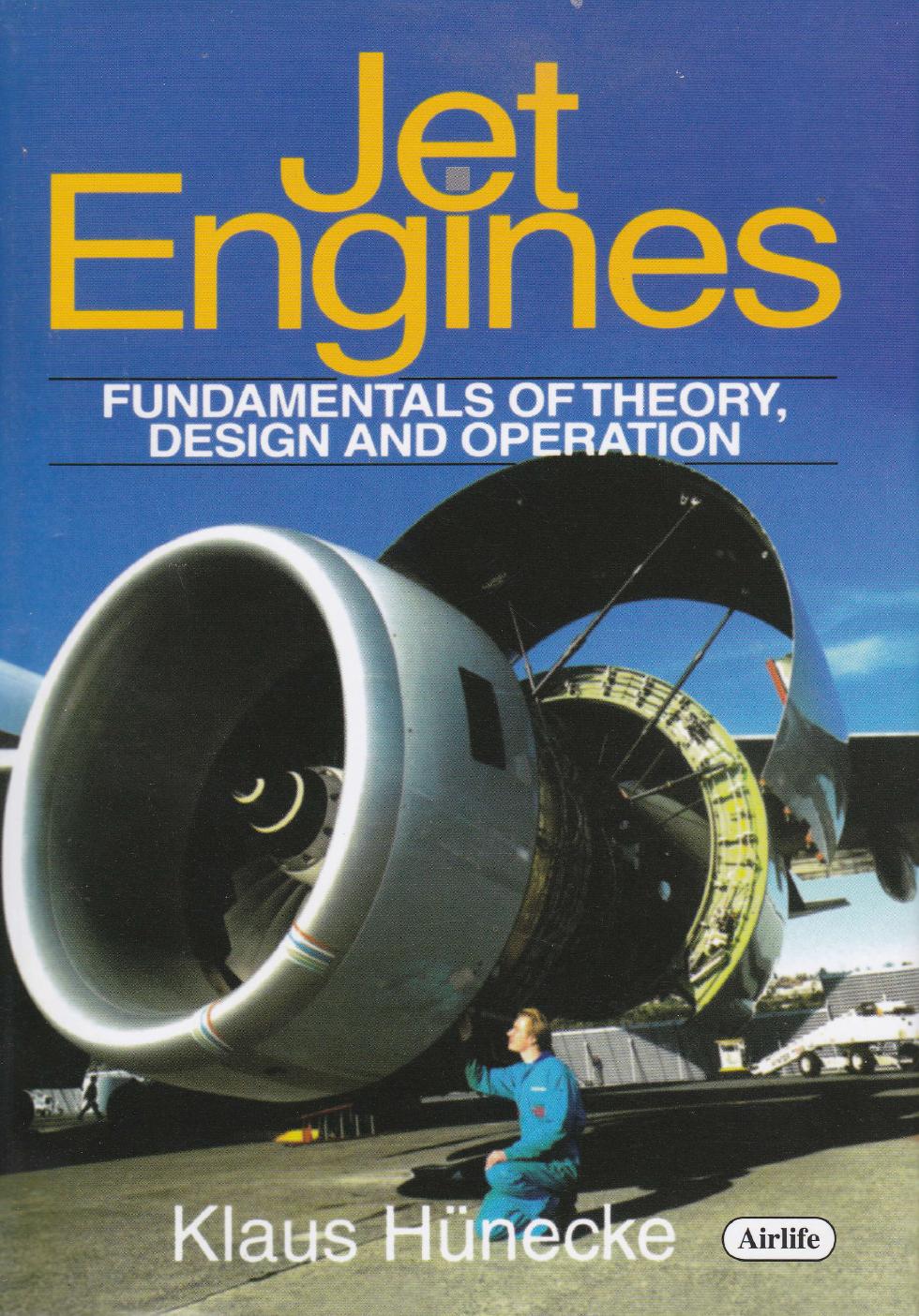
Book Review: Jet Engines: Fundamentals of Theory, Design and Operation

Klaus Huenecke
Jet Engines: Fundamentals of Theory, Design and Operation
Wiltshire, UK: Airlife Publishing, 1997
Category: Aerospace Engineering

Rating: 4-Stars


Much like Huenecke's book on Modern Combat Aircraft Design, Jet Engines provides an illustrated introduction to the principals of jet engine operation, analysis and manufacture, without delving into the detailed mathematics required to carry out a design study.  The chapters cover the individual components, such as the intake, the compressor, the combustor, turbine, and the nozzle, as well as airframe integration, providing a selection of illustrations to convey the essential theory and mechanical design of the propulsion system.

The chapter on compressors, for example, explains the differences between a centrifugal and axial compressor, provides photographs and illustrations for how a typical compressor is assembled, explains the theory behind compresor row velocity triangles, and even provides an example compressor map: illustrating the relationship between the corrected airflow, and the compressor pressure ratio.  The book therefore provides the principals behind compressor operation without getting bogged down into all of the mathematics that would be necessary to perform an actual design or trade studies.

Huenecke's book ultimately succeeds at what it was intended to be: an introduction to jet engine operations for the non-engineer.  The text is readable, and the illustrations help to convey the physical principals being described.  It is not an engine design text - but it was also not intended to be.  It is therefore an appropriate introduction to a subject that has been otherwise neglected in the non-engineering literature.

Sunday, October 4, 2015

Book Review: Hypersonic Airbreathing Propulsion

William H. Heiser and David T. Pratt
Hypersonic Airbreathing Propulsion
Washington, D.C.: American Institute of Aeronautics and Astronautics, 1994
Category: Aerospace Engineering

Rating: 5-Stars


This is one of those engineering texts that I wish they had had when I was in school.  Heiser and Pratt's Hypersonic Airbreathing Propulsion picks up where John Bertin's Hypersonic Aerothermodynamics leaves off, extending the basic concepts of hypersonic fluid dynamics to explore how they impact the operation of the propulsion system.  This volume explores the unique operating conditions and physics behind combined-cycle engines, as well as ramjet and scramjet operation.

The challenges of these flight conditions are unique to high speed flight.  Inlet losses that might have been tolerable for a "supersonic" aircraft at Mach 2, can become unacceptable to an aircraft at Mach 5.  A combustion system that was ruled by questions of mixing, burner efficiencies and minute pressure losses in subsonic combustion, becomes challenged by chemical kinetics and the brief residence time during supersonic combustion.  Moreover, even if these obstacles can be addressed, the supersonic combustion process is subject to the risk of thermal choking - wherein the addition of heat energy actually reduces the the Mach number of the flow, threatening to choke the burner and introduce a normal shock wave that could be catastrophic to the aircraft and engine.

For those who have been privileged to have explored this region of flight, or even for those who might hope to one day have that experience, this textbook is a doorway into the challenges of this unique design space.

Sunday, September 27, 2015

Book Review: Hypersonic Aerothermodynamics

John J. Bertin
Hypersonic Aerothermodynamics
Washington, D.C.: American Institute of Aeronautics and Astronautics, 1994
Category: Aerospace Engineering

Rating: 4-Stars


As aircraft move deeper into the supersonic realm, many of the assumptions that engineers might have taken for granted at subsonic or even lower supersonic Mach numbers, begin to fall into disarray.  As the air becomes superheated, passing through the high-strength shock waves around the aircraft, reentry vehicle or missile, it begins to deviate more and more from the ideal gas laws that so many of us have come to know and love.  In this high temperature environment, there is no longer a separation between aerodynamics, and thermodynamics.  You cannot model the one without the other.  Even the chemical composition of the air begins to change, as the molecules break-down to become high-temperature plasma.

This book is intended as an introduction to this flight regime, aimed at helping to reorient the engineer into the mathematics and physical modeling that are needed to design high speed aircraft, missiles, or re-entry vehicles.  As such, it forms the foundation for a journey, which for those who must design under these flight conditions, will become a fascinating road with fresh challenges, and new phenomena that were ignored at less strenuous flight conditions.  All told, a great start for further learning.

Sunday, September 20, 2015

Book Review: Practical Intake Aerodynamic Design

E.L. Golsdmith and J. Seddon, Editors
Practical Intake Aerodynamic Design
Washington, D.C.: American Institute of Aeronautics and Astronautics, 1993
Category: Aerospace Engineering

Rating: 4-Stars


Inlet design is no small part of how a jet aircrat either succeeds - or fails - to get the most out of its engine. This is an important element for subsonic operation, and a crucial element in supersonic flight.

As the title suggests, this is not a theoretical treatise, but an effort to assemble a practical guide to inlet design.  This text brings together a series of studies, by a variety of authors in the field, describing how developers quantify and alleviate such problems as inlet flow distortion, boundary layer ingestion, and variable supersonic inlet geometry. Included are empirical tools for providing first order estimates for pressure losses, as well as reviews of more specialized design challenges - such as inlets for STOVL aircraft.

In sum, Practical Intake Aerodynamic Design is an able companion to broader engineering design texts focused on either aircraft design or engine design.

Saturday, September 5, 2015

Book Review: Mechanics and Thermodynamics of Propulsion

Philip G. Hill and Carl R. Paterson
Mechanics and Thermodynamics of Propulsion
Reading, MA: Addison-Wesley Publishing Company, 1970
Category: Aerospace Engineering

Rating: 4-Stars


As its title suggests, Mechanics and Thermodynamics of Propulsion tackles the broad subject of modern aerospace propulsion, spanning everything from jet engines, to rocket motors, to the electric thrusters used by spacecraft.  As with any attempt to cover such a broad subject, the book covers its material in general, theoretical terms.

Much like Gas Turbine Theory, Mechanics and Thermodynamics of Propulsion provides an introductory, theoretical background without delving into the details necessary for engine design.  First published in 1965, it is still in use in college classrooms today, a testament to its enduring value as an introductory resource.  In my experience, it provides a solid thermodynamic foundation, but leaves its readers hungry for more solid meats.  Much like Gas Turbine Theory, it has served well for this intended purpose.  For those of us intent on delving into the details of propulsion system development and design, however, a more detailed account - such as that supplied by Aircraft Engine Design - will be needed.

Sunday, August 30, 2015

Book Review: Gas Turbine Theory

H. Cohen, G.F.C. Rogers and H.I.H. Saravanamuttoo
Gas Turbine Theory
Harlow, UK: Longman Scientific & Technical, 1987
Category: Aerospace Engineering

Rating: 4-Stars


The first edition of Gas Turbine Theory was originally published in 1951.  Updated many times over in the years since, the third edition first came out in 1987, and has had several printings since then.  The longevity of this title speaks to its role in fulfilling a fundamental need.

The text provides a good introduction into the theoretical foundations for the Brayton Cycle, which underlies all of jet propulsion.  It also provides an introduction into the components of turbomachinery - including such fundamentals, for example, as the calculation of entry and exit angles, and velocities across successive airfoil stages.

Where this book falls short is in its practical application.  Gas Turbine Theory is - as it claims - an introduction into the theory behind jet propulsion.  Aircraft Engine Design, on the other hand, is an introduction into the practicalities of conceptual engine design, engine sizing, and trade assessments.  For those wishing to touch on the theory of jet engines with broad brush strokes, Gas Turbine Theory is therefore a more than adequate text.  For those wishing to understand how the engine components and design process comes together into a functional engine, Aircraft Engine Design is by far the more valuable tool.  Perhaps it's a question of taste, but as an engineer, I have found the real satisfaction to be in the practical application and design process - not the theory.

Friday, August 21, 2015

Book Review: Aircraft Engine Design

Jack D. Mattingly, William H. Heiser and Daniel H. Daley
Aircraft Engine Design
New York: American Institute of Aeronautics and Astronautics, 1987
Category: Aerospace Engineering

Rating: 5-Stars


Aircraft Engine Design is easily the most comprehensive and directly relevant textbook available on jet engine design.  Now in its second edition, the text provides the underlying mathematics for the design of the propulsion system, as well as accompanying software to support trade studies during the conceptual design process.

The all-important, central role that the propulsion system plays in modern aircraft is often overlooked.  While there is a broad array of developers throughout the world that have successfully designed and produced a modern jet aircraft, only a handful have succeeded in developing a competitive jet engine.  In terms of complexity and the number of components necessary to make its operation successful, the jet engine easily exceeds the part count and design complexity of the airframe itself.  Which is why a book such as this is all the more vital as part of the engineering literature.

In addition to describing the mathematics and performance trades of the overall propulsion system, Aircraft Engine Design also relates the engine performance back to the aircraft's mission profile, providing the necessary relationships for calculating range and fuel burn.  Succeeding chapters, in turn, delve into the design of the individual engine modules, providing a high level overview into some of the challenges and technologies that go into the fan, compressor, burner, and turbine.

An indispensable resource for both aircraft and aircraft engine design principals.

Thursday, August 13, 2015

Book Review: Introduction to Aircraft Performance

Mario Asselin
An Introduction to Aircraft Performance
Reston, VA: American Institute of Aeronautics and Astronautics, 1997
Category: Aerospace Engineering

Rating: 5-Stars


Aircraft design begins and ends with performance.  Performance is what the customer is paying for.  It is where the designer begins during conceptual design - when assessing trade studies - and it is what the customer will judge the product against when it comes time to pay for the aircraft.  It is therefore perhaps long overdue that an engineering text devoted to this subject came into print.

The subject of aircraft performance, and the mathematics behind it, is also dealt with in Jan Roskam's multi-volume collection, and is touched upon in Dan Raymer's book as well.  Asselin's text, however, takes the study of performance to the next level: describing methods for calculating optimum cruise or climb conditions, and for assessing peformance trades in more detail.  My one disappointment was that, while this book does deal with the mathematics of energy maneuverability, it makes no attempt to describe the E-M diagram, or how to interpret one.  That aside, Asselin's book stands out as a much needed addition to the aircraft design literature.

Saturday, August 8, 2015

Book Review: Aircraft Design

E. Heinemann, R. Rausa, K. Van Every
Aircraft Design
Baltimore, MD: Nautical and Aviation Publishing Company of America, 1985
Category: Aerospace Engineering

Rating: 4-Stars


This slim volume contains a collection of aircraft design fundamentals, as told by Ed Heinemann - the chief designer in charge of naval attack aviation at Douglas Aircraft during the 1940s and 50s.  Although not as broad or deep in its scope as Jan Roskam's multi-volume set, and not as up-to-date as Dan Raymer's text, Heinemann's classic study still retains its practical charm.

Heinemann presents the fundamentals of combat aircraft design, without going too deep into the underlying details.  His book is therefore appropriate as an introductory text for someone who wants to understand the lay of the land, but who is not yet ready for all of the mathematics that preliminary aircraft design would demand.  The true attraction of this particular text for me, however, lies in the seasoned wisdom of the man behind it: a real airplane designer, not a professor ensconced in academia.  It is the practical perspective and advice that sets this book apart.